(Words and Lyrics by Paul McCartney and Denny Laine)
Mull of Kintyre, oh mist rolling in from the sea
My desire is always to be here
Oh Mull of Kintyre
Far have I travelled and much have I seen
Dark distant mountains with valleys of green
Past painted deserts, the sun sets on fire
As he carries me home to the Mull of Kintyre
Mull of Kintyre, oh mist rolling in from the sea
My desire is always to be here
Oh Mull of Kintyre
Sweep through the heather like deer in the glen
Carry me back to the days I knew then
Nights when we sang like a heavenly choir
Of the life and the times of the Mull of Kintyre
Mull of Kintyre, oh mist rolling in from the sea
My desire is always to be here
Oh Mull of Kintyre
Smiles in the sunshine and tears in the rain
Still take me back where my mem’ries remain
Flickering embers grow higher and high’r
As they carry me back to the Mull of Kintyre
Mull of Kintyre, oh mist rolling in from the sea
My desire is always to be here
Oh Mull of Kintyre
I find it easy to sense God on a mountain top, in a forest, under a blanket of stars, or on a beach. It is sometimes harder to sense God in the city. Cars roaring over asphalt and concrete, buildings towering to the sky, and lights blotting out our ability to see the stars make me think of man and the ways we have damaged creation. Yet, God is in the city. He is in those of us who choose to follow Him and make Him known. He is in the struggle for justice, peace, and love which goes on in the city. He cannot be removed, He is here whether or not we acknowledge His presence. Jesus is here in the city. He is here in the people who are His hands and feet to this place. Greater things are yet to come. Greater things are yet to be done in this city.
God of This City
You’re the God of this City
You’re the King of these people
You’re the Lord of this nation
You areYou’re the Light in this darkness
You’re the Hope to the hopeless
You’re the Peace to the restless
You areThere is no one like our God
There is no one like our GodFor greater things have yet to come
And greater things are still to be done in this City
Greater thing have yet to come
And greater things are still to be done in this CityThere is no one like our God
There is no one like our GodFor greater things have yet to come
And greater things are still to be done in this City
Greater things have yet to come
And greater things are still to be done hereThere is no one like our god
There is no one like our GodGreater things have yet to come
And greater things are still to be done in this City
Greater things have yet to come
And greater things are still to be done here*
*”God of this City”, written by Northern Irish band Bluetree and performed by Chris Tomlin and many others all over the world.
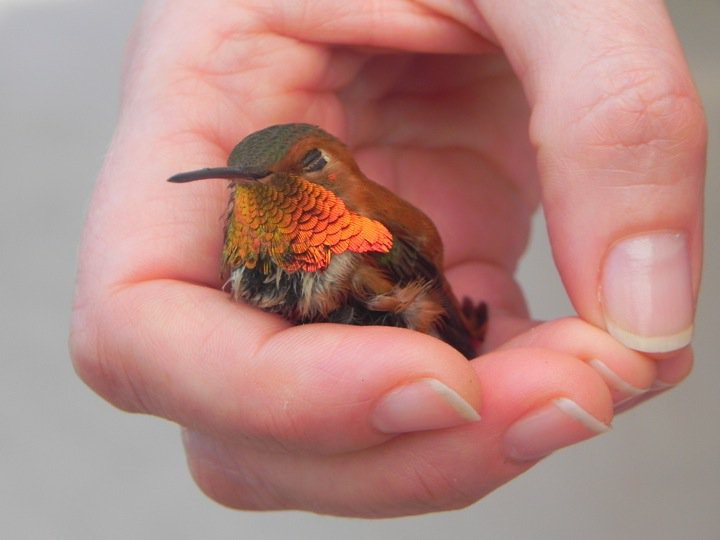
Last weekend we enjoyed the hospitality of some friends at their cabin. They have many hummingbirds coming to drink from their feeder. Sadly, while we were there, one of these beautiful birds flew into the window and lay stunned on the deck. We were able to get a good look at this amazing creature. They are one of the wonders of animal life on this planet. This hummingbird had iridescent feathers at its throat that changed colour at different angles, a preposterous looking beak, a miniscule tongue (forked at the end) which laps up the nectar, and powerful wings. The wings beat between 10 and 100 times per second, the tongue laps 13 times per second, and their hearts beat at up to 1200 beats per second. The world in which we live is truly awe inspiring. Annie Dillard says it well in her marvellous book, Pilgrim at Tinker Creek.
Certainly nature seems to exult in abounding radicality, extremism, anarchy. If we were to judge nature by its common sense or likelihood, we wouldn’t believe the world existed. In nature, improbabilities are the one stock in trade. The whole creation is one lunatic fringe. If creation had been left up to me, I’m sure I wouldn’t have had the imagination or courage to do more than shape a single, reasonably sized atom, smooth as a snowball, and let it go at that. No claims of any and all revelations could be so far-fetched as a single giraffe.*
*Annie Dillard, Pilgrim at Tinker Creek (New York: Perennial Classics, 1998), p. 146
In Beyond Homelessness, Walsh and Bouma-Prediger speak of the writings of Barbara Kingsolver.
In Speaking of our contemporary patterns of uprootedness, Kingsolver says that the urban “exodus from the land makes me unspeakably sad. I think of the children who will never know, intuitively, that a flower is a plant’s way of making love, or what silence sounds like, or that trees breathe out what we breathe in. . . . I wonder how they will imagine the infinite when they have never seen how the stars fill a dark night sky. I wonder how I can explain why a wood-thrush song makes my chest hurt to a populace for whom wood is a construction material and thrush is a tongue disease.”*
*Bouma-Prediger, Steven and Walsh, Brian J. Beyond Homelessness: Christian Faith in a Culture of Displacement. (Grand Rapids: Wm. B. Eerdmans Publishing Company, 2008), p. 188.
As I watch new stories of the oil slick in the Gulf of Mexico, it is sad to realize that my own hunger for things made from oil is part of the problem. Brian Walsh and Steven Bouma-Prediger (in their book Beyond Homelessness) speak of ecological homelessness and its causes. They describe ten such causes.
The tenth (and last) reason for ecological homelessness is anthropocentrism. The belief that we humans are at the center of the universe contributes both to the degradation of our home planet and to our own sense of homelessness on earth. Many now recognize that the so-called developed world’s worldview is overly human centered. Norman Wirzba puts it this way:
The eclipse of divine transcendence, once understood to be the source and goal of the world, created a hole that would be filled by human beings who now position themselves as the center or source of meaning and value. No longer microcosms of the creation, people are the autonomous beings who, in an expression of rational freedom, chart and direct the fate of themselves and the world. Again, the history of this development toward autonomy is complex. But what emerges is a self cut off from the world of which it is a part and a world shorn of all remnants of final causality. Nature, a self-regulating mechanism, stands as the arena on which reason and technique can be exercised.
Having banished or pacified God, we enthroned ourselves at the center of things. Following Protagoras, we believe that we humans are the measure of all things. With ourselves at the center and the world a machine, nature gets reduced to the status of an object – merely a resource to be used and, if necessary, abused. It is not difficult to see how such a perspective on the world and one’s place in it sanctions the despoliation of the earth. Viewing ourselves as autonomous creatures, fundamentally unrelated to either God or the rest of creation, we have shaped a culture, an economy, and a built environment subject to no principles beyond our own self-aggrandizing aspirations and with no sense of kinship with other creatures or their habitats.*
Your appetite and my appetite for oil leads drilling companies to dig it out of the ground many meters below the ocean surface without regard for the danger this process poses for a multitude of God’s creatures who rely upon a clean ocean for their food and well-being. We rationalize that we need this oil and we gamble with the lives of the other species who have no need of oil but also share this fragile planet.
*Bouma-Prediger, Steven and Walsh, Brian J. Beyond Homelessness: Christian Faith in a Culture of Displacement. (Grand Rapids: Wm. B. Eerdmans Publishing Company, 2008), p. 182, 183.
Saint Columba Day
St. Columba 521-597, Born probably in Donegal Ireland of royal descent he studied at Moville under St. Finnian then in Leinster at the monastery of Clonard under another St. Finnian. He was ordained before he was twenty-five and spent the next fifteen years preaching and setting up foundations at Derry, Durrow, and Kells. Possibly because of a family feud which resulted in the death of 3000 and for which he considered himself partly responsible he left Ireland at 42 and landed on the island of Iona off the coast of Scotland. There he built the monastery which was to become world famous. With SS Canice and Comgall he spread the gospel to the Picts; he also developed a monastic rule which many followed until the introduction of St. Benedict’s. He died on Iona and is also known as Colm, Colum and Columcille. Feast day is June 9.*
Columba was a missionary who, like Saint Patrick, took the message of Jesus to a wild and dangerous group of people. He trusted that God would care for him.
He was not only a great missionary saint who won a whole kingdom to Christ, but he was a statesman, a scholar, a poet, and the founder of numerous churches and monasteries. His name is dear to Scotsmen and Irishmen alike. And because of his great and noble work even non-Catholics hold his memory in veneration.#
In our family we often ask the question, “Which would you rather have: fame, or fortune?” My answer is always fame. A weakness of mine is that I want to be known as someone who accomplished great things. Chris Rice, in his song “The Power of a Moment,” helps me keep things in perspective.
The Power of a Moment
(Lyrics and music by Chris Rice)What am I gonna be when I grow up?
How am I gonna make my mark in history?
And what are they gonna write about me when I’m gone?
These are the questions that shape the way I think about what matters
But I have no guarantee of my next heartbeat
And my world’s too big to make a name for myself
And what if no one wants to read about me when I’m gone?
Seems to me that right now’s the only moment that mattersYou know the number of my days
So come paint Your pictures on the canvas in my head
And come write Your wisdom on my heart
And teach me the power of a moment
The power of a moment, the power of a momentIn Your kingdom where the least is greatest
The weak are given strength and fools confound the wise
And forever brushes up against a moment’s time
Leaving impressions and drawing me into what really mattersYou know the number of my days
So come paint Your pictures on the canvas in my head
And come write Your wisdom on my heart
And teach me the power of a moment
The power of a moment, the power of a momentI get so distracted by my bigger schemes
Show me the importance of the simple things
Like a word, a seed, a thorn, a nail
And a cup of cold waterYou know the number of my days
So come paint Your pictures on the canvas in my head
And come write Your wisdom on my heart
And teach me the power of a moment
The power of a moment, the power of, the power of, the power of a moment.*
God, come paint Your pictures on the canvas in my head!
*Chris Rice, “The Power of a Moment,” from the album, Past the Edges, 1998; Copyright Clumsy Fly Music (ASCAP).

Click on the picture to enlarge the image.
Having two daughters get married within six months of each other will either make you feel old or will cause you to think about love and your own marriage.
God is love, and all who live in love live in God, and God lives in them. And as we live in God, our love grows more perfect. So we will not be afraid on the day of judgment, but we can face him with confidence because we live like Jesus here in this world.
1 John 4:16, 17.
My prayer is that each day my own love for God, my wife and my children might grow more perfect. Love one another for love is from God.
Click on the picture to enlarge the image.

I have again been reading from Walsh and Keesmaat’s excellent book: Colossians Remixed. Here is a quote.
As we sat on a dock with a group of students late one night, the conversation turned to the question of why God made the world. We listened as the students went around and around on this one. Did God need the world? Was God lonely? Was there some preexisting force that God had to tame and direct toward creation? None of these answers were satisfying, until at last one student suggested that God made the world because God is love.
A reverent silence came over the group, and for a few minutes we all lay out on the dock looking at the stars, hearing loons call across the lake and feeling the air chill as we entered deeper into the night. Then someone quoted from Psalm 33: “For the word of the Lord is upright, and all his work is done in faithfulness. He loves righteousness and justice; the earth is full of the steadfast love of the Lord” (vv.4-5). The earth is full of the steadfast love of God! Even in the face of our ecological hate, our contemptuous rape of this creation of delight, the creation in its very being radiates the love of God.*
Weigh these words and see if they ring true. “The whole earth is full of the love of God.” “God created this world because He is love.” Talk about these things with trusted friends and people with whom you are in community.
*Walsh, Brian J. and Keesmaat, Sylvia C., Colossians Remixed: Subverting the Empire (Downers Grove: InterVarsity Press, 2004), p. 196.
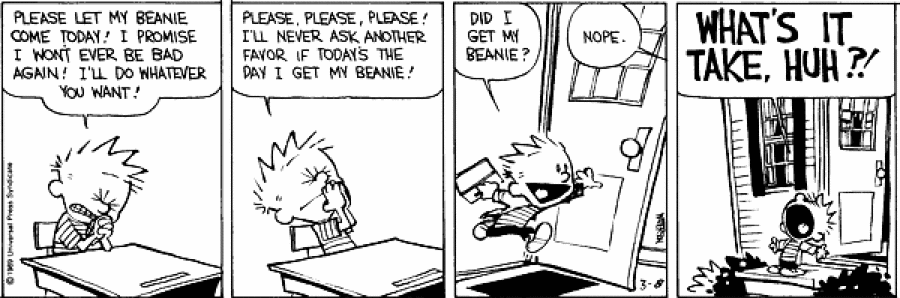
My prayer life on a bad day:
(Click on the image to enlarge.)