My musical friend Mike Charko reminded me of the amazing words of this song by “Jars of Clay.”
“Faith Enough” by Jars of Clay
The ice is thin enough for walkin’
The rope is worn enough to climb
My throat is dry enough for talkin’
The world is crumblin’ but I know why
The world is crumblin’ but I know whyThe storm is wild enough for sailing
The bridge is weak enough to cross
This body frail enough for fighting
I’m home enough to know I’m lost
Home enough to know I’m lostIt’s just enough to be strong
In the broken places, in the broken places
It’s just enough to be strong
Should the world rely on faith tonightThe land unfit enough for planting
Barren enough to conceive
Poor enough to gain the treasure
Enough a cynic to believe
Enough a cynic to believeConfused enough to know direction
The sun eclipsed enough to shine
Be still enough to finally tremble
And see enough to know I’m blind
And see enough to know I’m blindIt’s just enough to be strong
In the broken places, in the broken places
It’s just enough to be strong
Should the world rely on faith tonightShould the world rely on faith tonight
Tonight, Tonight, Tonight
This is a remarkable song that describes this tenuous life between hope and fear, power and weakness, strength and brokenness. I’m home enough to know I am lost. I’m enough a cynic to believe. Should the world rely on faith tonight?
Listen to the song here.
Romans 8:11 (NIV)
And if the Spirit of him who raised Jesus from the dead is living in you, he who raised Christ from the dead will also give life to your mortal bodies through his Spirit, who lives in you.
I don’t often write about theological concepts for I am not an academic theologian and cannot make definitive statements. Today I want to introduce a concept and encourage the reader to investigate further. I have been reading about what theologians say about resurrection. There is a myth that has been widely circulated that says that as followers of Jesus we do not need to concern ourselves with our bodies or any of the things of this world for one day Jesus will return, yank us out of these evil and broken bodies on this evil and polluted planet and take us far away from it all.
But what if there is continuity between what we have done in this world and the world to come?# Romans 8:11 makes it clear that it is our mortal bodies which will be given life just as Jesus’ mortal body was raised from the dead. Likewise, 1 Corinthians 3:12-15 says that some of what we build in this life will survive beyond the “Day of the Resurrection” and some will not.
1 Corinthians 3:10-15 (NIV)
By the grace God has given me, I laid a foundation as an expert builder, and someone else is building on it. But each one should be careful how he builds. For no one can lay any foundation other than the one already laid, which is Jesus Christ. If any man builds on this foundation using gold, silver, costly stones, wood, hay or straw, his work will be shown for what it is, because the Day will bring it to light. It will be revealed with fire, and the fire will test the quality of each man’s work. If what he has built survives, he will receive his reward. If it is burned up, he will suffer loss; he himself will be saved, but only as one escaping through the flames.
Some time ago I had a dream in which I could see beyond the exterior of people.* In this dream I could see people walking about in a church building and I could see an inner core of their being. The inner core was made of gold. Some had a very slender rod of gold at their centre. Others had a thicker rod. These rods represented the work that each individual had done to build upon the foundation of Jesus. Some had done more and some had done less. The golden rod in each person was capable of going through fire and surviving. This helped me to understand how it might be that as we live out our lives here on earth there are things that contribute to who we are as beings before God and there are things that do not contribute. A friend of mine speaks of kindnesses shown to other human beings versus watching four hours of sit-coms on television. It seems to both of us that one of these would contribute to what will survive a fire while one would not.
These are difficult concepts which require more thought. For the reader who would like to investigate these things further I recommend the book Surprised by Hope.#
#NT Wright expands upon this theme in his theological writings. See Wright, N.T. (2008). Surprised by Hope: Rethinking Heaven, the Resurrection, and the Mission of the Church. New York: HarperCollins Publishers.
*I do not claim that a dream such as this has any truth value but simply represents how my mind is trying to process a difficult concept. I explain the dream here in the hope that it may also help others to wrestle with these concepts.
Let nothing disturb you.
Let nothing alarm you.
Everything passes;
God does not change.
All things are
Accomplished with patience.
He who has God
Is lacking in nothing.
God is enough.
St. Teresa of Avila (Spanish Nun, Mystic and Writer, 1515-1582)
Matthew 5:6 Matthew 5:6 (New International Version)
Blessed are those who hunger and thirst for righteousness, for they will be filled.
I have given this passage much thought and meditated upon it many times and still have not plumbed the depths of it. The usual way we hear the passage is that it is saying to us that we should deeply desire to be righteous people. We hear it saying that we will be blessed if we long to be righteous. This sends us down an internal pathway of, “How can I do a better job of cleaning up my life and removing the sin from the crevasses of my soul?” We focus on spiritual disciplines and try to be more righteous in Bible reading, prayer, fasting, meditation, etc. This is all good and is perhaps one message we are to receive from Matthew 5:6. It is not the whole message nor is it the main message of Matthew 5:6.
The major message of this passage is that we are to hunger and thirst (long for, seek as though our lives depended upon it) for righteousness/shalom/justice in the world. Righteousness (dikaiosuna) has the sense of whatever conforms to the revealed will of God and things that are “just, equitable, and fair.”* Thus, when we see things that are not righteous in the world, when we see things that are not just, equitable, and fair, our hearts should long to see justice. When we see aboriginal women standing on the corner offering themselves for prostitution in the downtown eastside (DTES) of Vancouver our hearts should say this is not right, this is not just, this is not fair, this is not equitable, this is not shalom, this does not conform to the revealed will of God. Such things should make us long for righteousness in this situation. We should hunger and thirst that this thing should be made right. It should move us to action. “Blessed are those who hunger and thirst for righteousness, they will be filled/satisfied/saturated.” We cannot rest until we have filled our hunger and thirst for righteousness.
This morning, I was reading an article by Meera Bai and John Stackhouse called “Why I Help Addicts Shoot Up.” I have never been a supporter of InSite (the Vancouver safe injection site) and I still am not sure I can support it despite the reduction in harm it may accomplish. But when I read the article it made me hunger and thirst for righteousness in the drug culture of the DTES. Reading this article one can readily see that this is not right, this is not just, this is not shalom. Even InSite does not seem right, just, or equitable even though much grace, love, and care is being extended. The answer lies in hungering and thirsting for righteousness. We need to hunger and thirst for things that will stop the cycle. The authors say
Having witnessed three generations of the same family shoot up in the same room, I have come to understand that injection drug use is far from being the result of one bad decision. It is the outcome of a complex of systemic, familial and individual influences that must not be oversimplified to “It’s their fault. They should just quit and get a job.” I am still shocked by the stories of abuse that I hear at InSite.
This is not right. My heart hungers and thirsts for righteousness that will prevent the abuse that will prevent the need to dull the pain of the abuse. I hunger and thirst for other solutions to the pain. I hunger and thirst for something other than InSite. I hunger and thirst for the Kingdom of God.
*Take a look at the word meaning in W.E. Vine’s, An Expository Dictionary of New Testament Words or Harold K. Moulton’s, The Analytical Greek Lexicon Revised.
It occurred to me that my blog has been pretty serious lately. Perhaps it is time to inject a bit of fun and beauty. Here are a few images from downtown Vancouver. Click on the photos to enlarge.
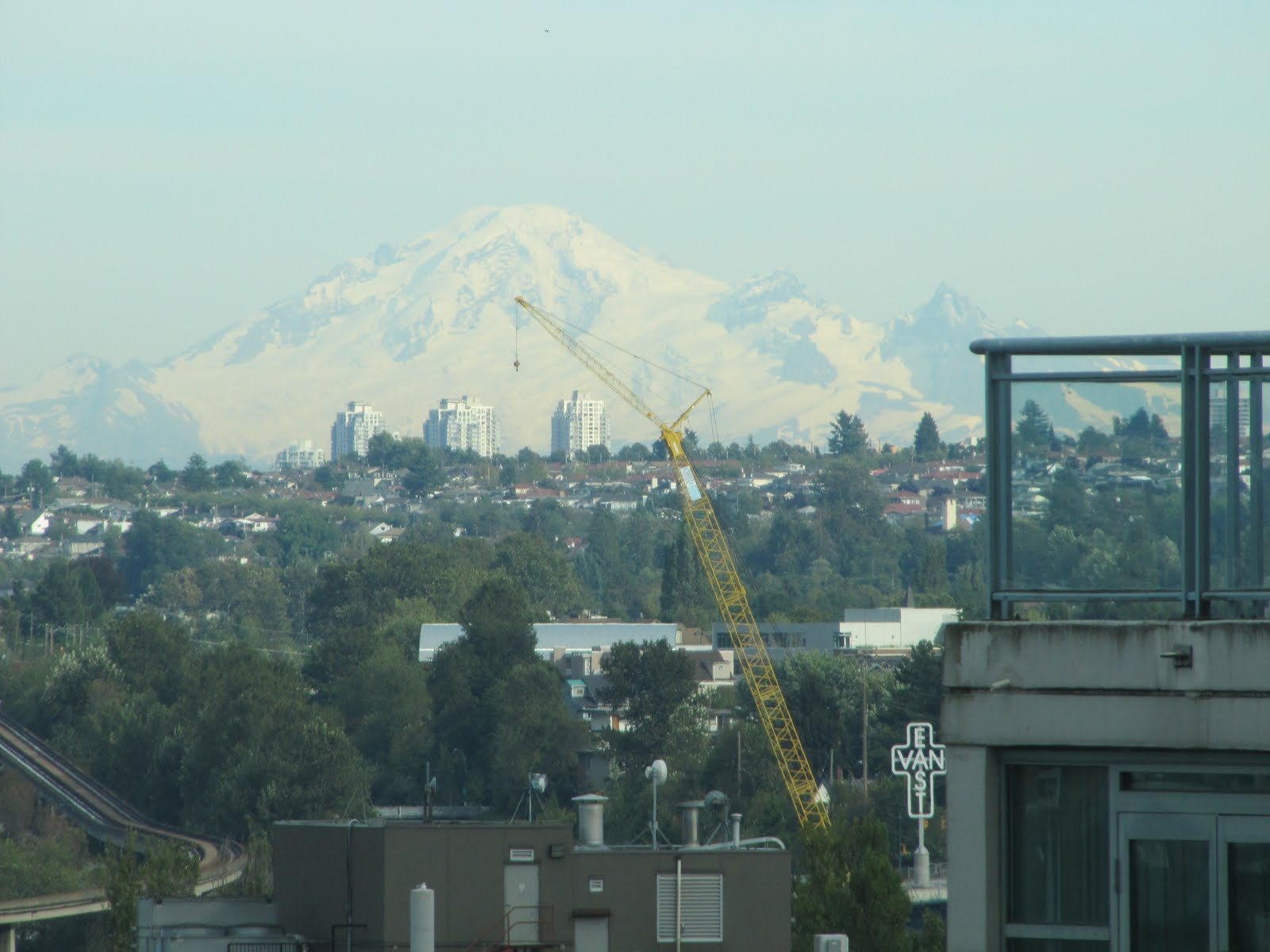
This picture says so much about Vancouver: condos, new construction, mountains, SkyTrain tracks, East Van Cross.

Construction of the new retractable roof on BC Place. A close-up.

Construction in the distance.
Rainy night in Vancouver.
“Consumerism, is a social and economic order that is based on the systematic creation and fostering of a desire to purchase goods or services in ever greater amounts.”# Most of us know what consumerism has done to our western world; and by now we are probably familiar with what the North American culture of consumerism has done to the church. It has created churches which try to out-do each other in providing services, programs, and goods. It has led to pastors who feel they must provide a congregation with a multitude of things that meet the felt needs of those who attend. It causes pastors to worry that if they don’t meet all these needs someone else will come along who will meet these needs and the people will trade them in for a better church experience.
I recently spoke with a pastor who told me that he really wanted the people in his church to get into small groups to serve their neighbours and their neighbourhoods. He dreamed of the day when people would come to see this as the priority and be less focussed on the kind of music in the Sunday morning worship service. With just a bit of irony in my voice, I told him that our church had developed a simple system for solving the perpetual problem of people attending the Sunday morning gathering and not attending small groups – we got rid of the the Sunday morning gathering.
Hugh Halter says,
There’s only one way to overcome the problem of consumerism. Not two or three ways, not a program, not a sermon for you to preach or a class for you to teach. Just one way to break the pattern:
You have to remove what they are consuming.
. . . if what we give to people isn’t appreciated, doesn’t inspire them toward the life of Christ, or doesn’t lead them to real growth, your only option is to provide less . . . .*
We think Halter has it right. LifeHouse Christian Church is seeking to be a place where we limit our consumerism and seek to care for and lead each other toward Christ. May God guide us and give us wisdom as we stumble toward this goal.
#http://en.wikipedia.org/wiki/Consumerism
*Halter, H., & Smay, M. (2010). And: The Gathered and Scattered Church. Grand Rapids: Zondervan.
Recently, I had the privilege of being the “best man” at a wedding. I met the groom, whom I now count as a friend, seven years ago. We met through an organization called COSA# on the day that he was released from a federal penitentiary. This friend has been through many challenges and ups and downs but yesterday was a great day of celebration as he and his bride said “I do” and committed themselves to each other.
As about thirty of us gathered around this couple and celebrated with them, it was great to see the transformation that had taken place in this man’s life. And it was great to see that these thirty people had become a family to this couple. People can change. Many times people do not change because they do not have a family. For many of us, a family is what offers us the support and accountability that we need. A family provides respect and encourages growth. Very few of the thirty people in the room were actually biologically related to the couple but we were all family. I am thankful to have had a part in the transformation of this man’s life. I am thankful for the community that is standing with this couple as they move forward in commitment together.
#COSA is a highly effective organization that makes a difference in criminal recidivism. I encourage all readers to consider volunteering as a COSA circle member. For information about your local COSA click here.
I have been pondering these verses from the book of Jeremiah.
This is what the LORD says:
“Cursed is the one who trusts in man,
who depends on flesh for his strength
and whose heart turns away from the LORD.He will be like a bush in the wastelands;
he will not see prosperity when it comes.
He will dwell in the parched places of the desert,
in a salt land where no one lives.“But blessed is the man who trusts in the LORD,
whose confidence is in him.He will be like a tree planted by the water
that sends out its roots by the stream.
It does not fear when heat comes;
its leaves are always green.
It has no worries in a year of drought
and never fails to bear fruit.” Jeremiah 17:5-8 (New International Version – NIV)
Heal me, O LORD, and I will be healed;
save me and I will be saved,
for you are the one I praise. Jeremiah 17:14 (NIV)
We can be like a tree planted by the water. We will bear fruit for our Lord.
Jeremiah 12:1-5 (New Living Translation)
1 Lord, you always give me justice
when I bring a case before you.
So let me bring you this complaint:
Why are the wicked so prosperous?
Why are evil people so happy?
2 You have planted them,
and they have taken root and prospered.
Your name is on their lips,
but you are far from their hearts.
3 But as for me, Lord, you know my heart.
You see me and test my thoughts.
Drag these people away like sheep to be butchered!
Set them aside to be slaughtered!
4 How long must this land mourn?
Even the grass in the fields has withered.
The wild animals and birds have disappeared
because of the evil in the land.
For the people have said,
“The Lord doesn’t see what’s ahead for us!”
(The Lord’s Reply to Jeremiah:)
5 “If racing against mere men makes you tired,
how will you race against horses?
If you stumble and fall on open ground,
what will you do in the thickets near the Jordan?
Eugene Peterson says that God’s answer to Jeremiah was this:
Life is difficult, Jeremiah. Are you going to quit at the first wave of opposition? Are you going to retreat when you find that there is more to life than finding three meals a day and a dry place to sleep at night? Are you going to run home the minute you find that the mass of men and women are more interested in keeping their feet warm than in living at risk to the glory of God? Are you going to live cautiously or courageously? I called you to live at your best, to pursue righteousness, to sustain a drive toward excellence. It is easier, I know, to be neurotic. It is easier to be parasitic. It is easier to relax in the embracing arms of The Average. Easier, but not better. Easier, but not more significant. Easier, but not more fulfilling. I called you to live a life of purpose far beyond what you think yourself capable of living and promised you adequate strength to fulfill your destiny. Now at the first sign of difficulty you are ready to quit. If you are fatigued by this run-of-the-mill crowd of apathetic mediocrities, what will you do when the real race starts, the race with the swift and determined horses of excellence? What is it you really want, Jeremiah? Do you want to shuffle along with the crowd, or run with the horses?
It is understandable that there are retreats from excellence, veerings away from risk, withdrawals from faith. It is easier to define oneself minimally (“a featherless biped”) and live securely within that definition than to be defined maximally (“a little less than God”) and live adventurously in that reality. It is unlikely, I think, that Jeremiah was spontaneous or quick in his reply to God’s question. The ecstatic ideals for a new life had been splattered with the world’s cynicism. The euphoric impetus of youthful enthusiasm no longer carried him. He weighed the options. He counted the cost. He tossed and turned in hesitation. The response when it came was not verbal but biographical. His life became his answer. “I’ll run with the horses.”*
The thing I note about God’s answer is that God challenges Jeremiah to look at things differently. Jeremiah complains to God and, rather that hearing soft words of comfort, Jeremiah hears a rebuke. God says, “This is not about you Jeremiah! Get over yourself. I have plans for this world that you cannot comprehend. You are not yet living up to the potential I see in you. Stop complaining about how hard this task is. I am calling you to something harder!”
I too have a choice before me today. Will I complain to God about how hard it is to run a footrace with men? Or, will I get up and run with horses?
*Peterson, E. H. (2009). Run With The Horses. Downers Grove: InterVarsity Press, p. 21, 22.
Yesterday I raced in the Vancouver Triathlon in Stanley Park. This is the main race that keeps me training all year long. I look forward to the 1.5 km swim in the ocean, the 40 km bike ride through the Stanley Park roadways with no car traffic, and the 10 km run on the paths of Stanley Park. There was a moment as I pedalled hard up a hill toward Prospect Point when I looked at the moss covered trees and the ferns around me and thought, “Wow, what a beautiful place to race.”
Of course, yesterday, I was doing all of this in the rain. Everyone gets wet in the swim but usually you dry off on the bike. Not yesterday, the puddles, and spray and constant rain kept us wet and cool. Then came the run – in soggy shoes.
I learned some things from this race. I learned that you can train all year for an event but there is always the possibility of unforeseen challenges. Who would have thought that the biggest struggle of the day would have been taking off my bike helmet? My hands, cold and numb from my handle-bars, did not have the manual dexterity or strength to pinch the clasp to release my helmet.
I learned that the race is very much a mental challenge as well as a physical challenge. My brain tried to convince me several times that I was doing poorly. Reminding myself that I was in one of the most beautiful parks in Canada, enjoying a day of swimming, cycling and running, gave me the perspective I needed to enjoy the race and ultimately succeed in a personal best time.
I learned that it is fun to encourage each other to do well at a triathlon. Everyone has the jitters before a race like this. As we stood on the beach about to plunge into the cold Pacific ocean, the good natured joking and bantor helped us all to relax. Toward the end of the third event, the 10 km run, we were all dragging a bit. I started singing, “We are the champions, my friend, and we’ll keep on fighting to the end.” I saw a few smiles, heard a few out-right laughs and a few who turned it up a notch because of the prod. On the next time around the course the volunteers were making requests, “How about ‘Eye of the Tiger.'” To which I dutifully responded with “It’s the eye of the tiger; it’s the thrill of the fight, rising up to the challenge of our rival . . .” We all had a better day as we laughed at the incongruity of it all.
Triathlons have become a metaphor of life for me. I train my body and my mind. I am thankful for the chance to be a part of the race in this beautiful world. I learn to deal with the unexpected difficulties. I keep a right perspective. I encourage others. I enjoy the moment. I laugh.